Frankenstein, revisited by Guillermo del Toro
This publication is also available in:
 Français
  English (UK)
  Deutsch
  Italiano
  Español
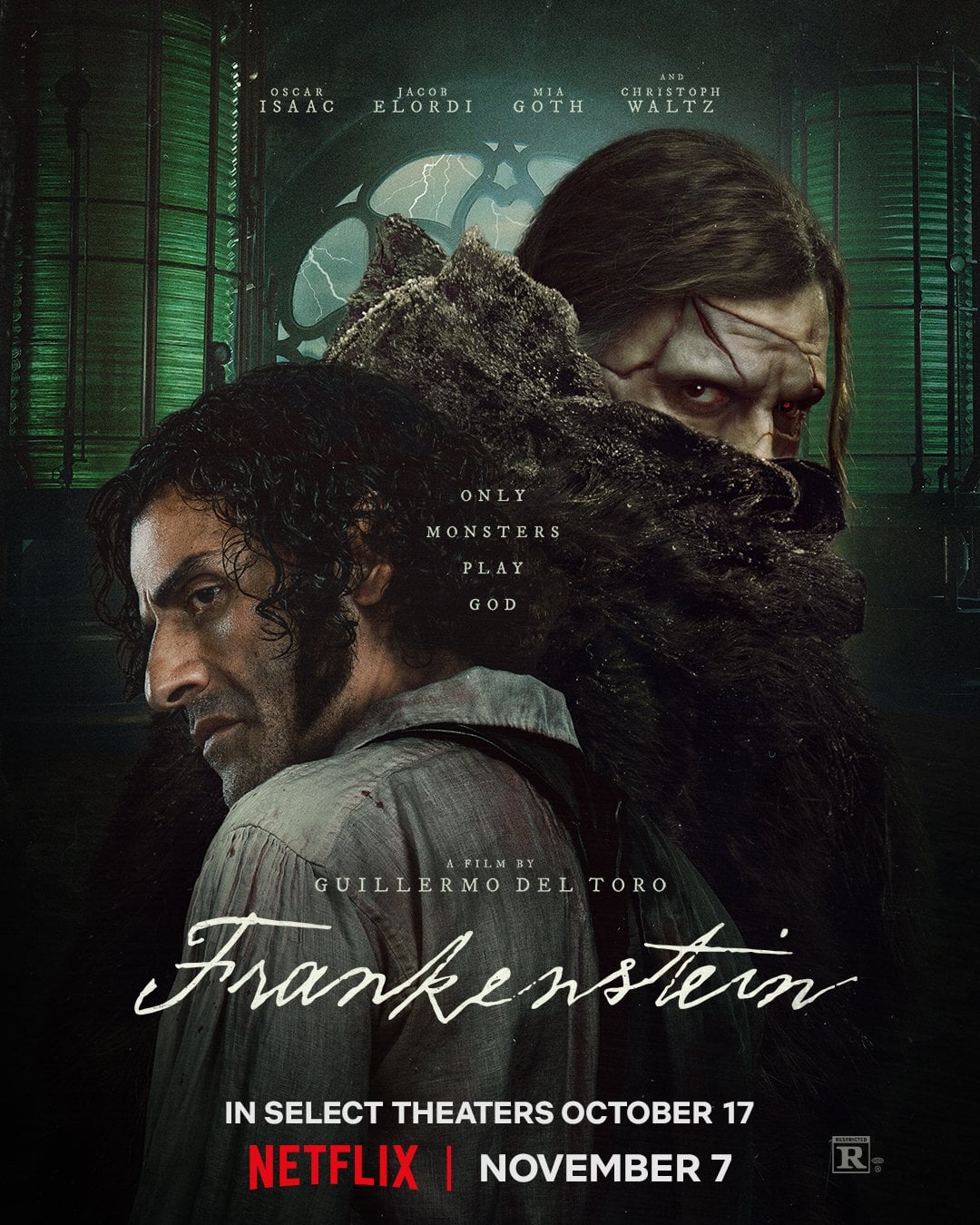
A few days before its release on Netflix (November 7), I invite you today for a first dive into the hypnotic universe of Guillermo del Toro’s Frankenstein. Adapted from Mary Shelley’s work, this gothic tale unfolds here through a personal and enchanting lens. Having had the chance to discover the film on the big screen at the London Film Festival, I also visited the Frankenstein, Creating a Tale Eternal exhibition at the Old Selfridges Hotel in London to uncover all the behind-the-scenes secrets. Between Victorian costumes, creature design, and an exceptional collaboration with Tiffany & Co, I share here the magic that emanates from this reinterpretation.
Frankenstein, as seen by Guillermo del Toro
A great admirer of the Mexican director’s work, Guillermo del Toro’s Frankenstein was one of the films I was most looking forward to in recent years. And the result exceeded my expectations!
This new adaptation of Mary Shelley’s novel aims to be very personal. The author, having written her novel from an autobiographical perspective, inspired the director to do the same, incorporating themes that are dear to him and that he has explored in the past (religion, paternal figures, notions of loss, solitude, love…).
Dreaming of this adaptation for many years, he unveils here a captivating and unique version of the tale, blending the gothic with influences from telenovelas. All of this is anchored in a breathtaking setting and led by a brilliant cast, combining strength and emotion.
We find elements unique to Guillermo del Toro’s creativity. Notably, his desire to work with real sets (including the construction of a ship, the laboratory…) as well as to use practical effects (puppets, prosthetics, and makeup for the creature…). His intentions give the film that unique and authentic soul, wrapped in the music of Alexandre Desplat (The Shape of Water, Pinocchio).
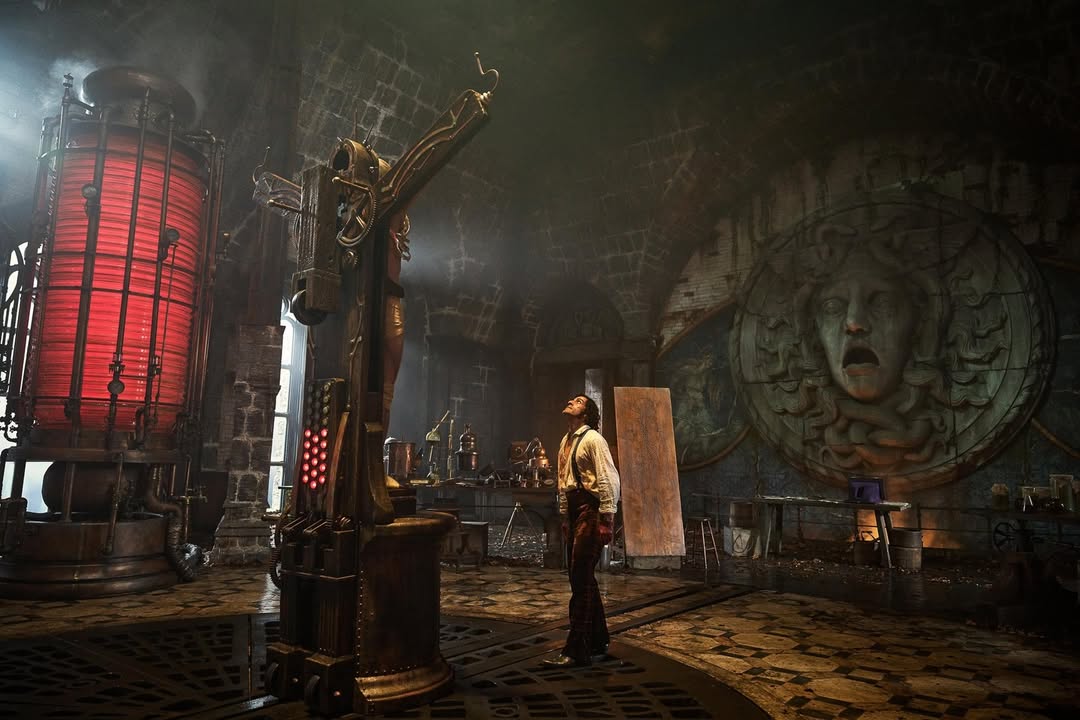
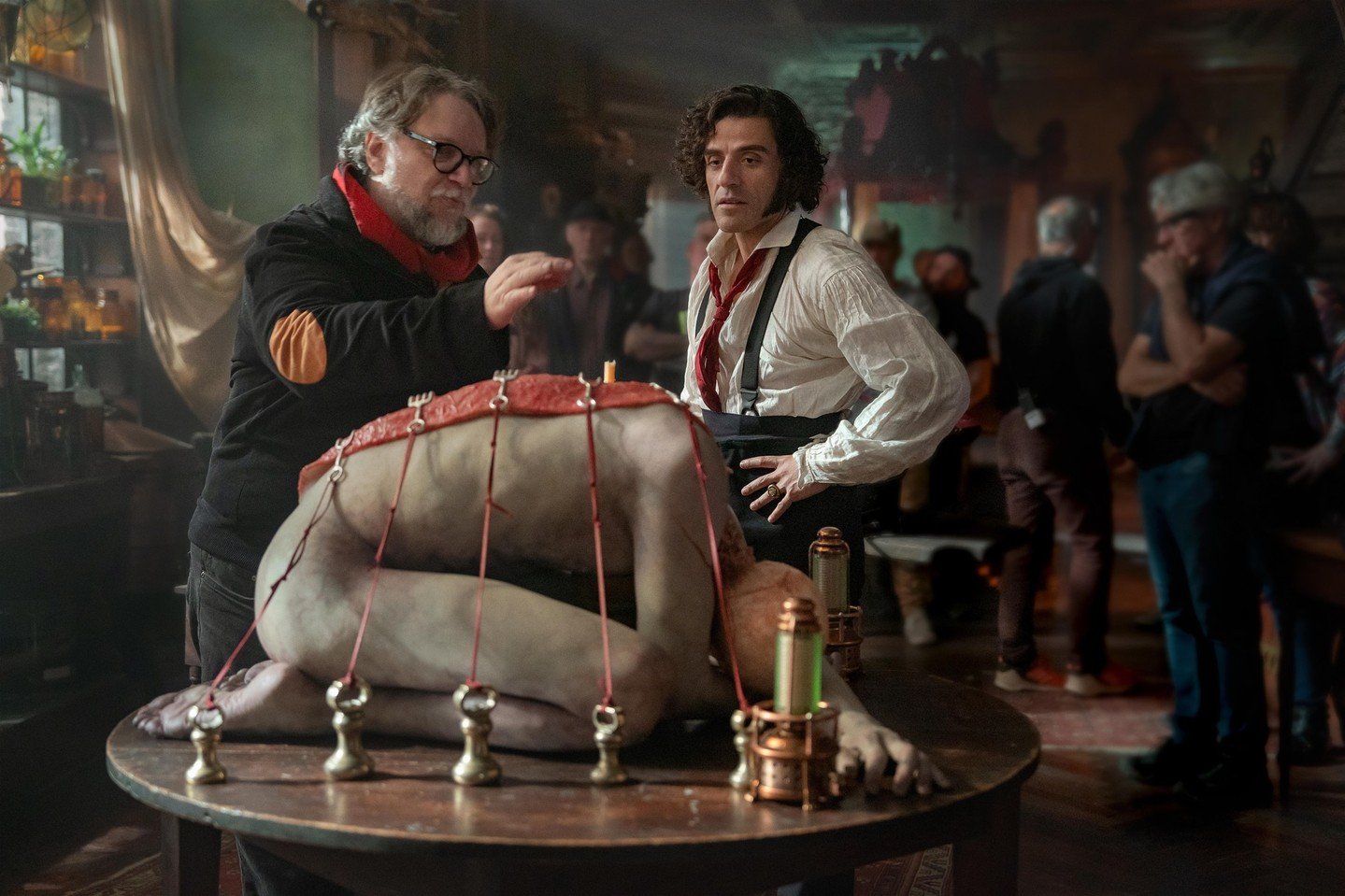
The Narrative through Costumes
As mentioned in an interview with Collider, colors play an essential role in the narrative of Frankenstein. Whether through set elements, lighting, or costumes, they reinforce the film’s structure and the presence of characters.
Set in two time periods, the first in the 1830s (Victor’s youth), and then in the 1850s (Victor’s present), the film is rooted in the Victorian era as well as the context of the Crimean War.
To design the costumes, Kate Hawley drew inspiration from the film’s context, but also from her own feelings after rereading Frankenstein (melancholy, solitude, disintegration of nature…), the emotional weight of the script, and Guillermo del Toro’s desire for colors + the gothic framework of the film to honor.
Familiar with 19th-century attire, the costume designer sought to go further. Specifically, by embracing a vision of the Victorian era that few people are aware of: the attraction to colors.
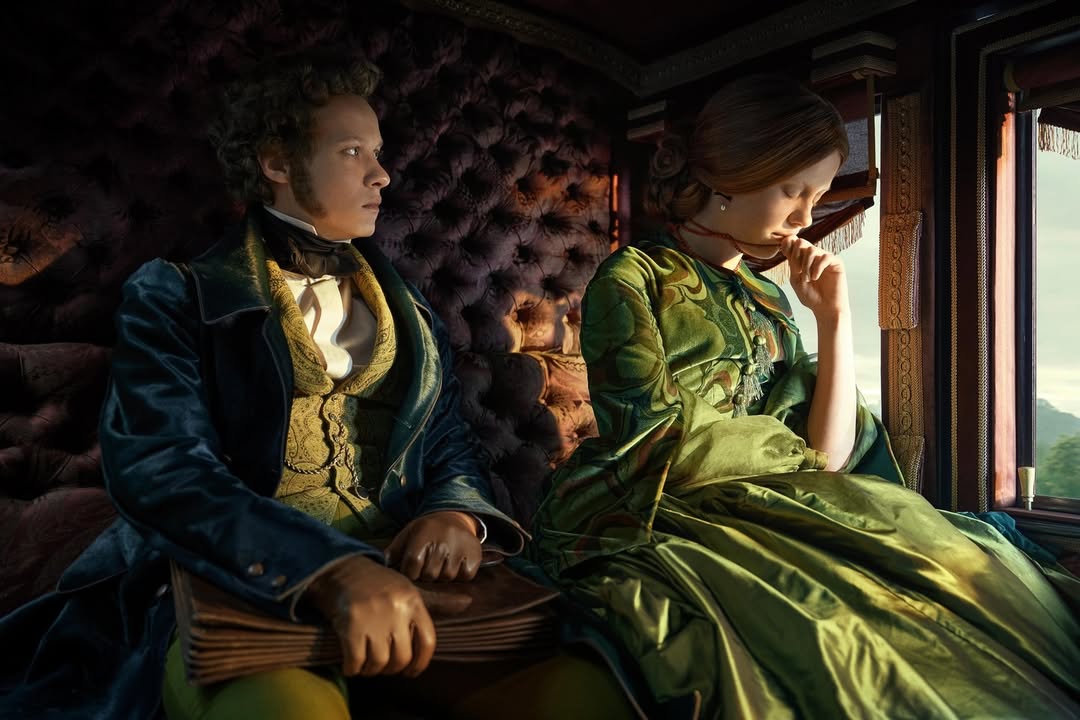
Consequently, red, blue, green, and yellow are vividly present in the costumes. They are notably used through patterns reminiscent of nature (mineral patterns – malachite for Elizabeth) or fine veils, adding a fantastical touch to certain characters.
A Historic Collaboration with Tiffany & Co
To complete the outfits, the director and costume designer were able to rely on the support of Tiffany & Co. A historic collaboration, on one hand, because the jewelry house is the first to partner with a Netflix production. But also, because the research and crafting work led the team to delve into the past and the archives of the jeweler.
Guillermo del Toro and Kate Hawley were thus able to bring their ideas to life with the guidance and expertise of Christopher Young (head of archives and design – Vice President & Creative Director at Tiffany & Co), accompanied by the master engraver, goldsmith, the gemstone and crystal acquisition team, as well as the innovation workshop of the house (all enchanted by their ideas).
Very quickly, common themes emerged between Mary Shelley’s work, the director’s adaptation, and Tiffany & Co’s heritage. Particularly, a fascination for nature, insects, metamorphosis, and love.
Among the more than 6,000 objects and documents in the archives, it was the works of Louis Comfort Tiffany (son of the founder) and his collaborators, Julia Munson (enamel artist) and Meta Overbeck (chief designer), that resonated with the desires of Kate Hawley and Guillermo del Toro. More specifically, a glass beetle pendant, which emerged as an obvious choice for the character of Elizabeth (who is passionate about insects).
This inspired the creation of a crucifix, combining a carnelian cross from the house with this insect, blown glass from Favril. This unique piece, rich in symbolism (renewal), illustrates the character’s faith and spirituality while providing a meaningful detail to the outfits.
The house also lent its “Scarab necklace”, its prestigious “The Wade Family Necklace,” as well as a ring featuring a green tourmaline surrounded by a gold vine.
Frankenstein: Crafting a Tale Eternal, the exhibition that celebrates teamwork
To explore the behind-the-scenes making of Guillermo del Toro’s Frankenstein, Selfridges has designed an exceptional exhibition in London, in partnership with Netflix. Presented alongside the London Film Festival (ending on 11/9), the installation offers a unique dive into the film’s universe.
Among set elements, costumes, props, puppets, sketches, behind-the-scenes photos, reports, and many testimonies from Guillermo del Toro and department heads… The visit is fascinating and reflects how much this film relies on the work of a great team of enthusiasts. And that warms the heart!
Mark your calendars for November 7 on Netflix to discover the film – which, unfortunately, has only had a few limited screenings in theaters 🙁
Photos: © Netflix